Best Practices to Prevent Outgassing in Adhesive Assemblies
Minimizing the release of volatile substances can ensure the performance of sensitive components.
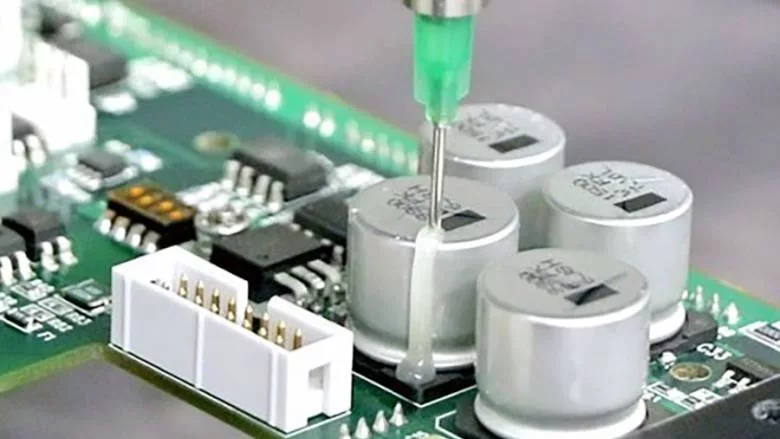
Adhesives with low ionic contamination maintain electrical insulation integrity and prevent corrosion-related failure, ensuring long-term reliability.
Adhesive bonding is a popular assembly process because it enables engineers to create strong joints. But industrial adhesives have several drawbacks, such as outgassing, which can cause problems in some applications.
When a material is exposed to a vacuum or low-pressure condition, adhesives can release gases, which can contaminate surroundings or interfere with sensitive equipment.
This particularly affects aerospace applications and products that rely on optical components, optoelectronics or photonic systems. Semiconductors and medical imaging devices, such as endoscopes, are also prone to problems.
Outgassed substances can corrode and degrade delicate electronic components. They can also cloud lenses and create performance issues.

Satellites and other spacecraft are susceptible to outgassing issues. Photo courtesy Northrop Grumman Corp.
Out-of-This-World Problems
Outgassing poses significant headaches to spacecraft engineers, since satellites and other devices are subjected to extreme temperature fluctuations due to the sun’s unfiltered radiation. The issue is exacerbated by the fact that a craft’s colder surfaces typically include crucial components such as cameras, lenses, mirrors and sensors.
“If a substance gets heated up and gives off condensable volatiles in a vacuum, they’re going to be drawn right onto cold surfaces,” warns Debbie Thomas, a senior materials engineer at Ball Aerospace, which runs NASA’s Outgassing Laboratory as a contractor at NASA’s Goddard Space Flight Center.
The facility tests materials by placing them in 50 percent humidity for 24 hours, followed by 24 hours in a vacuum at 125°C. Any condensable volatile compounds flow through a hole in the chamber to a collector plate held at 25°C. The material is then weighed to determine the total mass lost due to heating in the vacuum, and the plates are weighed to determine the collected volatile condensable material.
Looking for quick answers on assembly and manufacturing topics? Try Ask ASM, our new smart AI search tool. Ask ASM
“Outgassing is the release of volatile compounds from materials over time, particularly under heat, vacuum or pressure changes,” says Lindsay Hampton Varma, global senior market segment manager for defense and space adhesive technologies at Henkel AG. “Uncontrolled outgassing can contaminate sensitive components, reduce product reliability and interfere with coatings, optics, electronics and precision assemblies.
“In aerospace, outgassing is especially critical, because contaminants cannot dissipate in vacuum environments,” explains Varma. “Even trace emissions can deposit on optical surfaces, sensors, solar arrays and avionics, degrading mission performance and long-term reliability. For spacecraft and high-reliability aerospace systems, low-outgassing materials are essential for contamination control and mission assurance.”
In addition to satellites and other types of spacecraft, low-outgassing adhesives are commonly used in avionics and electronic assemblies, guidance systems, RF systems, sensors, solar panels and thermal control systems.

Because they’re cold, mirrors and lenses used in space telescopes are among the first places any volatile compounds outgassed from a spacecraft’s materials will condense, causing fogging. Photo courtesy NASA Goddard Space Flight Center
Growing Demand
According to Varma, demand is growing rapidly in aerospace applications, such as autonomous drones, commercial space and low-earth-orbit satellite constellations, CubeSats, electric vertical take-off and landing (eVTOL) aircraft and space-based optical communications. “As systems become smaller, more integrated and more contamination-sensitive, low-outgassing performance is becoming increasingly important,” she points out.
“Low-outgassing adhesives are required across many different applications and industries,” adds Oliver Matyssek, product manager for hard disk drive and wafer level micro-optics at DELO Industrial Adhesives. “Optical modules, such as cameras, lidar sensors and diode lasers, demand low-outgassing adhesives to significantly reduce condensable outgassing on critical optical components.
Hard disk drives demand even stricter outgassing specifications to avoid any contamination in the tightly packed gaps between the read-and-write arms and the rotating disks,” Matyssek points out.
“Low-outgassing adhesives require three key formulation strategies,” says Matyssek. “First, manufacturers select raw materials with minimal volatile content and high molecular weight polymers that naturally resist vapor emissions. To achieve this, catalyst systems and crosslinking density [must be precisely controlled] to trap potential volatile compounds within the cured network.
“Unreacted monomers are minimized by using molecules with multiple, highly reactive functional groups that increase the probability of network incorporation during curing,” explains Matyssek. “However, these requirements often conflict with other adhesive properties, like low viscosity or high flexibility, creating significant formulation challenges that require careful balance and optimization.”
Low-outgassing adhesives are specifically formulated to minimize the release of volatile compounds during curing and throughout the product’s lifetime.
“The key is reducing the amount of low-molecular-weight components that can evaporate or migrate under heat or vacuum exposure,” says Stephan Pröller, business development manager at Hoenle Adhesives GmbH. “Several formulation factors are important, including high-purity raw materials with low residual monomer contents; optimized photoinitiator and catalyst systems; controlled additive packages; and high crosslink density after curing.
“The curing behavior is equally important,” notes Pröller. “Even a well-designed adhesive can exhibit increased outgassing if it is incompletely cured and residual reactive species remain in the material.”
Hoenle’s two most recent low-outgassing adhesives are Vitralit E-1672 and Vitralit UH 1640. The former is ideal for active alignment applications, while the latter is designed for lens bonding applications used to produce cameras, microscopes, telescopes and other products.

Low-outgassing adhesives are important to prevent optical lenses from fogging. Illustration courtesy Hoenle Adhesives GmbH
Standardized Testing
Outgassing can be tested using standardized methods. The primary standard is ASTM E595, which measures total mass loss and volatile condensable materials under controlled vacuum and temperature conditions.
If detailed information on the identity and the amount of specific outgassing compounds is required, a combination of gas chromatographic separation and mass spectrometry is often performed.
“NASA and ESA (European Space Agency) testing is typically performed by specialized independent laboratories or aerospace qualification labs,” says Pröller. “Standardized outgassing tests are often only the starting point. In many optical applications, companies additionally perform fogging tests or optical transmission measurements.”
“The curing method plays a crucial role in outgassing performance,” adds Matyssek. “Incomplete curing or excessive temperatures can leave unreacted monomers or create degradation products, which are both sources of unwanted outgassing.
“However, a higher temperature might even help to bake out the components that release gases during curing,” explains Matyssek. “UV-curable adhesives offer distinct advantages by curing rapidly and completely at room temperature, minimizing thermal stress and volatile formation.”
DELO recently developed Photobond FB4151 for use in aircraft interiors. The UV- and light-curing acrylate cures within a few seconds and achieves high strengths of around 20 megapascals on various plastics and metals, while maintaining high flexibility. It is has low outgassing and is solvent free.
“Low-outgassing, low-ionic-content and light-curable adhesives that meet NASA E595 and MIL-STD-883 Method 5011 are essential for the assembly and protection of space and aerospace electronics,” says Virginia Hogan, senior business development manager for aerospace and energy at Dymax Corp.
“MAPTIS-listed products, such as Dymax 9773, provide engineers with verified options for ruggedizing, staking, underfill and encapsulation, delivering proven performance reliability and manufacturing efficiency in vacuum and high-reliability environments,” explains Hogan.
According to Hogan, the low-ionic-content, low-outgassing material is designed for demanding low-earth-orbit applications and next-generation spacecraft.
“Low-ionic content reduces the risk of corrosion or dendritic growth on printed circuit board (PCB) traces and solder joints, which can lead to electrical failure in mission-critical electronics.” notes Hogan.
“Even trace amounts of ionic contamination—chlorides, sodium or potassium—can attract moisture or create conductive pathways that promote corrosion or shorting,” claims Hogan. “In vacuum or low-humidity conditions, those residues become more reactive once systems cycle through temperature extremes.”
Adhesives with low-ionic contamination maintain electrical insulation integrity and prevent corrosion-related failure, ensuring long-term reliability for high-value systems such as avionics, defense platforms and satellites.
“Light-curable adhesives cure rapidly on demand under ultraviolet or visible light, allowing precise placement and immediate handling, reducing processing errors and component movement before cure,” says Hogan.
“In production environments, especially where delicate assemblies such as ball-grid arrays, chip-scale packages or fine-pitch components are used, engineers need adhesives that stay in place before curing and then harden instantly once positioned,” warns Hogan.
“The high viscosity of Dymax 9773 adhesive allows it to remain exactly where dispensed, even on vertical or angled surfaces, with demonstrated slump resistance at 90 F for up to 72 hours, until it’s cured,” claims Hogan.
“This controllable cure process minimizes rework and accelerates throughput, making the adhesive ideal for PCB ruggedization, staking or underfill alternatives used in aerospace electronics,” explains Hogan.

Lidar sensors and other advanced driver assistance system components must be assembled with low-outgassing adhesives. Illustration courtesy DELO Industrial Adhesives
Common Mistakes
The most widely recognized outgassing standard is ASTM E595, which was originally developed by NASA to evaluate materials used in spacecraft and vacuum environments. The test is commonly just referred to as the NASA outgassing test.
“The ESA pendant is ECSS-Q-ST-70-02C,” says Pröller. “ASTM E1559 is used when more detailed outgassing data is needed, especially for spacecraft contamination modeling.
“Some engineers believe that passing a standard outgassing test automatically guarantees suitability for every application,” Pröller points out. “ASTM E595 or ECSS compliance is valuable, but these are screening methods.
“Real application conditions may involve different temperatures, long operating lifetimes, high optical power densities, humidity or close proximity to sensitive optical surfaces,” explains Pröller. “A material that passes standard limits may still require additional validation in a specific optical system.”
According to Pröller, engineers sometimes focus only on the adhesive itself, while underestimating the influence of curing quality and process cleanliness. However, the curing method plays an important role in outgassing.
Engineers should also remember to follow three important steps:
- Optimize the curing process. “Complete curing is critical,” warns Pröller. “Proper UV dose, exposure geometry, thermal post-curing and process validation help minimize residual volatile content.
- Avoid excessive adhesive volumes. “Using only the necessary amount of adhesive reduces the total volatile load within the system,” says Pröller.
- Use bake-out procedures when appropriate. “In high-end optical or aerospace systems, components with cured adhesives are sometimes preconditioned through controlled bake-out cycles before final assembly,” adds Pröller.
For more information on adhesives, read these articles:
Looking for a reprint of this article?
From high-res PDFs to custom plaques, order your copy today!